How to count 101
What number lies in-between 1 and 9? Ask this to your neighbour, and you will likely get the answer “5”. Ask the Mundurukú people of the Amazon this question, and they will respond with “3”. This tribe, whose members never formally learn to count like we do in the rest of the world (using a mental linear number line), intuitively seem to count using a logarithmic number line. The linear number line thus appears to be a cultural invention and does not develop naturally in the absence of study. [1] As a matter of fact, this same effect can be observed in young children. When presented with a number line ranging from 0-100, kindergartners tend to assign more space to smaller numbers, placing the number 10 roughly in the middle of the number line. When asking this same question to children in 3rd grade, this effect decreases and the number line resembles the linear one learned in school. [2]
What other unique methods of counting do we know of?
One, Two, More.
The aforementioned Mundurukú people, like other indigenous cultures found in the Amazon and Australia, do not have names for most numbers like we have. The Mundurukú specifically, only have terms for numbers up to 5. A quantity higher than 5 is referred to simply as 'some', or 'many'. Despite having no specific terms for numbers larger than 5, the Mundurukú are able to compare and add large approximate numbers far greater than 5. [3]
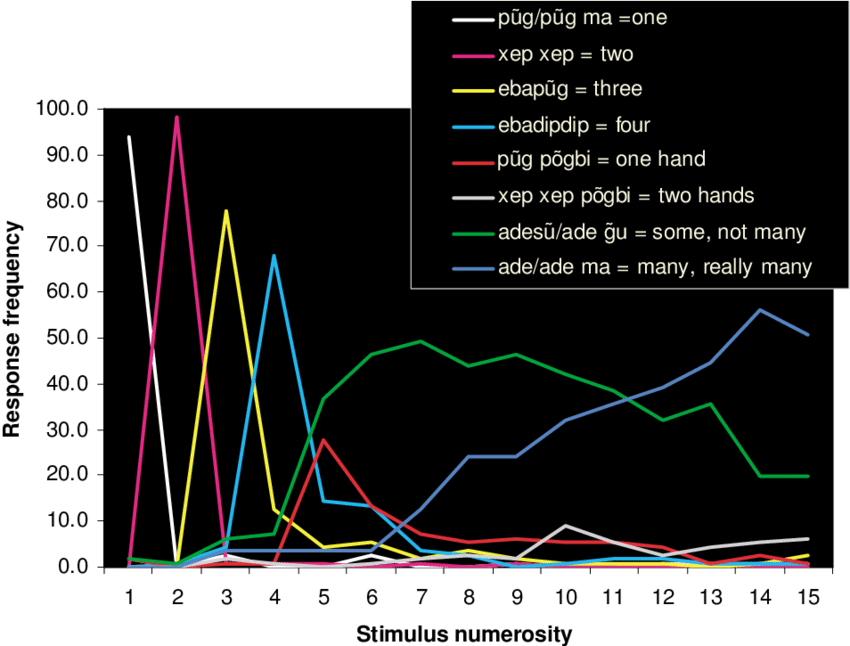
The Pirahã people, about 500km west of the Mundurukú, do not possess any words for exact numbers. To indicate quantities, the Pirahã use two basic terms: "hói" (a small amount or size) and "hoí" (a larger amount or size). Because the Pirahã have no concept of numbers, they naturally do not have any concept of counting or arithmetic. Note that this is not caused by a lower intellect. The Pirahã do not live in genetic isolation, mixing with people from surrounding populations regularly. Their intellect can thus not be too different from said surrounding populations, who do have a number system (albeit a simple one). [4]
Another quirk of the Pirahã language is the fact that they lack many color terms. To describe a color, speakers use descriptive comparisons tied to known physical objects. For example, red would be described as 'blood-like' and green would be described as 'unripe-like' [5]. As it turns out, this is not too different from the ancient Greeks. In 1858, future PM of the United Kingdom William Ewart Gladstone discovered that, in Homer's Iliad and Odyssey, it seemed like terms for various colors were not present in the vocabulary. The 'sea', for example, was referred to as 'wine-dark' (oinops). The sky would be described as 'bronze' or 'iron', and 'honey' or fresh vegetation would both be called 'green' (chloros). [6]
Based counting
Humans have 10 fingers, making the base-10 counting system we use quite intuitive. Perhaps a base-12 system would be more efficient for everyday use (12 has more factors & base-12 naturally aligns with planar geometry and spatial division (circles are 360°, 24 hour days, etc.)), But unfortunately, we were not born with 12 fingers.
The Oksapmin people from Papua New Guinea do not use their 10 fingers to count, but use 27 locations on
their upper body to count, resulting in a base-27 system. Counting starts at the thumb of the left hand (1),
moves up the fingers, to the wrist (6), elbow (7), shoulder (8), collarbone (9), neck (10), ear (11), eye
(12), nose (13), and then down the symmetry of the right side, ending at the right pinky finger (27).
Though arithmetic is not part of traditional life, Oksapmin children who learn arithmetic in school
naturally use their system to deal with arithmetic problems. [7]
Click here to see an Oksapmin auntie count.
Perhaps just as intuitive as using our ten fingers as a base, the Yuki, based in Northern California, use the eight spaces in between our fingers as a base for counting, resulting in the base-8 octal system (Something I remember learning in primary school with the book 'Het Land van Okt'). [8]
The ancient Sumerians perhaps had the most practical counting system (or maybe they wanted to hide the inflation), using a base-60 system around 3000 BCE, using a sub-base of 10. Like 12, 60 is a highly composite number with no less than 12 factors, making computations with fractions simpler, avoiding numbers with repeating decimals. [9]
4 x 20 + 10 + 7
In high school I took French for a couple years. Unfortunately I do not remember much of it, but the weirdness of how the French describe large numbers always stuck with me. The classical example being 97: 'quatre-vingt-dix-sept', meaning 'four-twenty-ten-seven'. By computing (4×20+10+7) we see that we indeed get 97.
I guess I should be thankful that I did not take the Nigerian Yoruba language in high school, as the Yoruba not only use a base-20 system, but compose numbers by subtraction, instead of addition. Numbers are built by jumping ahead to the next multiple of 20, after which a smaller number is subtracted to reach the desired number. 16, would thus become 'ẹẹrin din logun', or 'four taken away from twenty'. To make it a bit more complex, 45 would be 'aadorun-un dín marun-un', translating to 'five taken from ten taken from three twenties' - or (20×3)−10−5=45. [10]
[1]: https://pubmed.ncbi.nlm.nih.gov/18511690/
[2]: https://psycnet.apa.org/record/2006-00646-015
[3]: https://pubmed.ncbi.nlm.nih.gov/15486303/
[4]: https://pubmed.ncbi.nlm.nih.gov/18547557/
[5]: https://www.journals.uchicago.edu/doi/abs/10.1086/431525
[6]: Gladstone, W. E.
(1858). Studies on Homer and the Homeric Age (Vol. 3).
Oxford University Press.
[7]: https://psycnet.apa.org/record/1986-15762-001
[8]: Kroeber, A. L. (1911). The languages of the coast of California north of San
Francisco.
[9]: Sexagesimal. In Wikipedia.
[10]: Yoruba numerals. In
Wikipedia.