China's (anti)fragility
A common, quite disturbing historical statistic that gets thrown around is the insanely high number of deaths that occurred in an arbitrary historical Chinese (civil) conflict. One famous example is the An Lushan Rebellion [1], where a military general turned rebel attempted to overthrow the Tang dynasty's ~130 year rule. Total deaths? Estimates vary, but range from 13,000,000 to 36,000,000. One might think that this is simply due to the fact that China has (and had) absurdly many people. Naturally, any conflict in China would also bring with it a large number of victims. When we look at the relative number of deaths that occurred in ten major Chinese conflicts, and compare it to the relative number of deaths that occurred in ten major European conflicts, we see the following results (courtesy of Google Gemini):
Major Chinese Conflicts
| Conflict | Date | Est. Total Deaths | Relative Toll |
|---|---|---|---|
| Three Kingdoms War | 184-280 | 36M-40M | ~30-40%+ |
| An Lushan Rebellion | 755-763 | 13M-36M | 25-50% |
| Mongol Conquest of Jin/Song | 1211-1279 | ~30M | ~25-30% |
| Qing Conquest of Ming | 1618-1683 | ~25M | ~15% |
| Taiping Rebellion | 1850-1864 | 20M-30M | 5-7.5% |
| Sino-Japanese War (WWII) | 1937-1945 | 15M-22M | 4-5% |
| Dungan Revolt | 1862-1877 | 8M-20M | 2-5% |
| Chinese Civil War | 1927-1949 | 8M-12M | 2-3% |
| Yellow Turban Rebellion | 184-205 | 3M-7M | 6-14% |
| Miao Rebellions | 1854-1873 | ~5M | ~1% |
Major European Conflicts
| Conflict | Date | Est. Total Deaths | Relative Toll |
|---|---|---|---|
| World War II (European Theater) | 1939-1945 | 40M-50M | 7-9% |
| World War I | 1914-1918 | 15M-20M | 3-4% |
| Russian Civil War | 1917-1922 | 7M-12M | 5-8% |
| Thirty Years' War | 1618-1648 | 4M-8M | 5-10% |
| Napoleonic Wars | 1803-1815 | 3.5M-7M | 2-3.5% |
| French Wars of Religion | 1562-1598 | 2M-4M | 10-20% |
| Seven Years' War | 1756-1763 | 800k-1.3M | <1% |
| War of the Spanish Succession | 1701-1714 | 400k-1.2M | <1% |
| English Civil War | 1642-1651 | ~200k | 4-5% |
| Gallic Wars | 58-50 BC | ~1M | 20-30% |
As we can see, China, even when accounting for population, experienced much more deadly conflicts than Europe has. There are various reasons for this. For one, most casualties in these historical conflicts were not soldiers, but civilians dying of starvation and disease. China developed its bureaucracy earlier than Europe, enabling more efficient conscription and much larger armies. This not only led to larger battles, but feeding these massive armies stripped food from the countryside, triggering widespread civilian famines. Another reason is the fact that China kept better records of its population. In Europe, the lack of a rigorous census likely led to the undercounting of civilian casualties caused by the wars.
Fragility
I present one more reason, based on the concept of (anti)fragility from Nassim Taleb's Antifragile [2]. In short, an antifragile system lies directly opposite to a fragile system. Where a fragile system dislikes and breaks due to random events, an antifragile system thrives on random events, becoming stronger by them. In chapter 5, Taleb talks about what happens when antifragile systems are hurt when they are deprived of their natural variations (see figure 1). While the first system (on the left) may seem more volatile than the second system (on the right), in the long term the first system is much less volatile (and more antifragile) than the second. While the second system might seem more stable at first, the moment a negative shock happens, the consequences are severe.
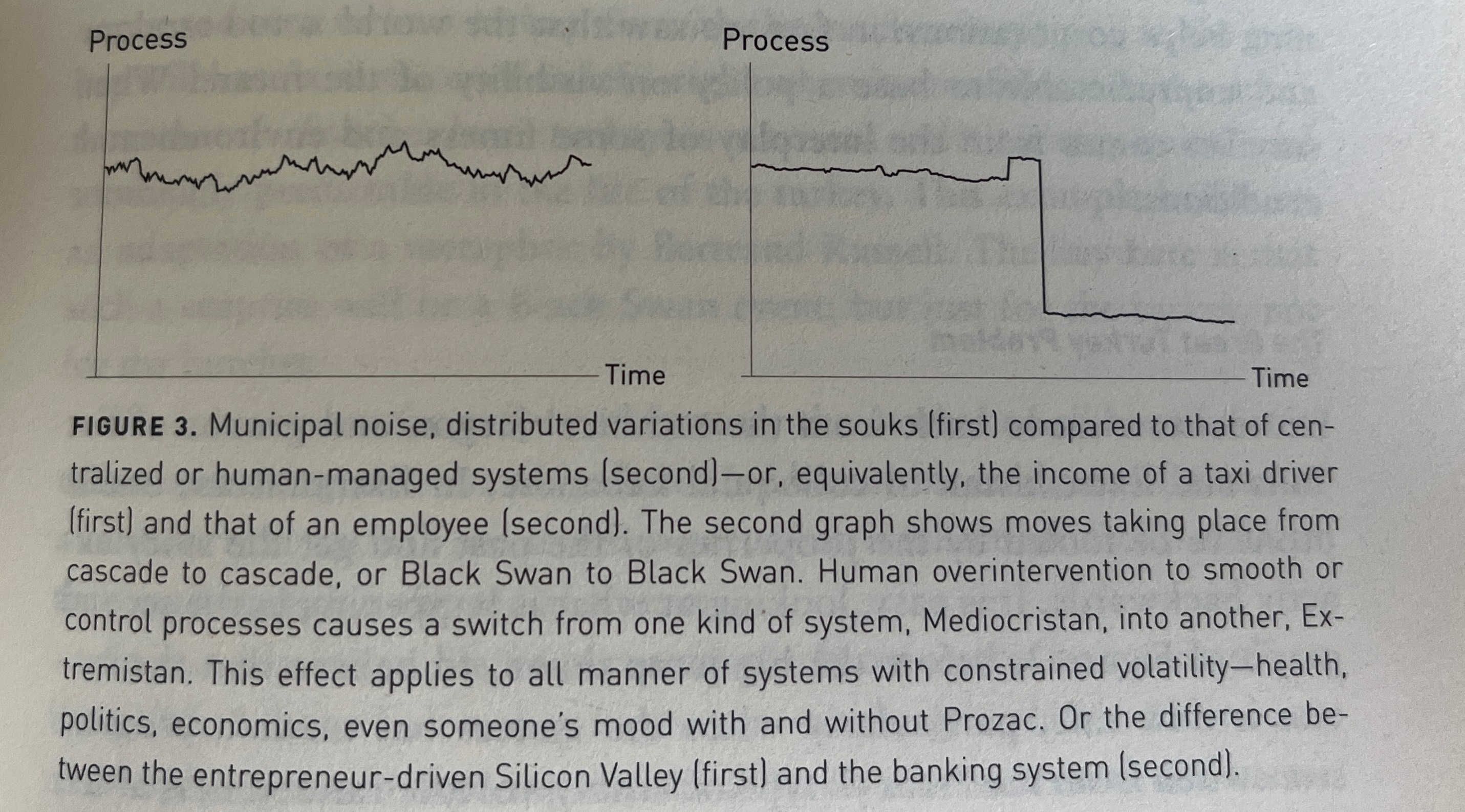
For this, we first need to understand the difference between the pre-modern European states and pre-modern China. As stated previously, China centralized much earlier than Europe. Small European states have always been in and out of conflict with their neighbours, introducing small variability similar to the first system in figure 1. To quote Taleb: "Tension was always present somewhere but without large consequences". China, on the other hand, has for most of its history been ruled by autocratic, centralized dynasties. This system brings (short-term) stability. While life under the emperor seems stable and preferable to that of the ever war-waging European system (I am talking about military conflicts here, not about instability created by e.g. a bad harvest), whenever some conflict does happen, the scale is massive; the result we see in the second system of figure 1. The system is only pseudo-stable, resulting in long-term fragility. Crucially, the small-scale volatility of the European system makes the system as a whole more stable.
This dynamic also explains why democracy seems to be the most optimal system in the long term. While in the short-term it might seem that nothing gets done quickly, politicians are fighting about everything, etc., this volatility dampens the eventual blow caused by some Black Swan event. Like the point made in this blog post, we should embrace our ideological opponents entering the political stage. The short-term volatility such a disrupter causes to the system will only feed the system's antifragile nature, making it end up stronger. In a non-democratic system where people can not express their political beliefs, the absence of small-scale political volatility lets 'explosive' tendencies accumulate under the surface, which will get out eventually (and with a lot of blood).
Zooming out
Lastly, you might ask: if the Chinese political system is so fragile, how has the civilization survived for over 5,000 years? The answer lies in the difference between the parts and the whole. In Taleb's framework, the fragility of the parts is often required for the antifragility of the macro-system. The individual dynasties are highly fragile, routinely collapsing under pressure. But the broader cultural and bureaucratic substrate is profoundly antifragile, using the chaos of these dynastic resets to endure and regenerate over millennia.
[1]: An Lushan rebellion. In Wikipedia.
[2]: Taleb, Nassim Nicholas. Antifragile:
Things That Gain from Disorder. Random House, 2012.